
Psychological Impact on Parents
 Having helped child victims of dog bites for nearly 30 years, we decided to write about the emotional impact on parents when their child is involved in a dog attack, because attacks on young ones are so common in Pennsylvania. Let’s first talk about a parent’s legal rights to sue for distress, even if the parent had not been bitten.
A Parent’s Legal Rights
 Based on current Pennsylvania law, parents may recover for their emotional distress, if they had directly witnessed the attack on their child (by sight, sound, or other immediate experience), see Hoffner v. Hodge, 47 Pa.Comm. 277, 407 A.2d 940 (1979). However, if the parent only learned of the attack after it occurred, without seeing or hearing it contemporaneously, a claim for emotional distress generally does not exist.
 Historically, Pennsylvania courts required physical impact for emotional distress claims. See Bosley v. Andrews, 393 Pa. 161, 142 A.2d 263 (1958). This evolved to include the “zone of danger” requirement. See Niederman v. Brodsky, 436 Pa. 401, 261 A.2d 84 (1970).
However, the landmark decision in Sinn v. Burd, 486 Pa. 146, 404 A.2d 672 (1979) established the current three-part test for such claims:
-
- The parent-plaintiff need only be in the zone of danger or directly witnessed the attack (e.g., by sight or sound);
- The parent’s emotional shock or stress resulted from observing the attack; and,
- The plaintiff and the victim were closely related as family members, i.e., a parent-child relationship.
Importantly, it is no longer necessary for the parent to have been in the “zone of danger” when witnessing an attack on a family member, as long as the other criteria are met.
Difference From Claims For a Child
A parent’s claim for her own emotional distress is totally different from her child’s claim. Each have different rights and procedures. For example, a parent only has 2 years from the date of the attack to sue for the emotional distress the parent suffered in relation to the attack on a child. A child, on the other hand, has 2 years from his or her 18th birthday to file suit. Plus the child’s claim requires court approval to settle, while the parent’s does not. Contact us for more details.
Types of Claims
So what might a parent’s claim — for “emotional distress” from witnessing an attack on her child — entail?
A Parent’s Shock and Trauma
 When a child is attacked by a dog, parents often find themselves reeling from overwhelming shock—especially if they witnessed the attack or arrived moments later. They may feel helpless or utterly unprepared for such violence. It may take time for a parent to process and accept a permanent change to their child’s appearance. And dealing with a child’s long term fear of canines can drain the parent’s mental resources.
Guilt and Self‑Blame
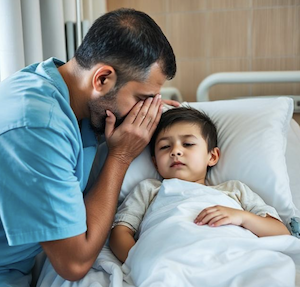 Even when an attack is not their fault, parents may blame themselves, thinking: “I should have prevented this.” Studies show that parents in these situations frequently report feelings of guilt and worry for their child’s safety and future, especially concerning scars or lasting effects.
Anxiety, Fear, and PTSD
Parents may experience intense anxiety, nightmares, flashbacks, or a constant sense of fear—signs commonly associated with post‑traumatic stress disorder (PTSD). These symptoms can mirror what children also endure and may significantly disrupt daily life.
Behavior Changes and Hyper-vigilance
Trauma can trigger hyper-vigilance; parents may become overly cautious, avoiding canines—or even pet‑friendly environments—out of fear that the incident will recur. These intense emotional reactions are common after witnessing or experiencing a dog attack.
Impact on Family Dynamics
The stress doesn’t end with the emotional shock. Parenting stress can elevate significantly—leading to exhaustion, strained relationships, avoidance, and even emotional distancing from other children or partners, according to Wikipedia. For families in more rural parts of Pennsylvania, or areas where mental‑health resources are scarce, these challenges can feel even more isolating.
Long‑Term Worries
 Many parents remain stressed and anxious, themselves, over long-term effects on their child—like social withdrawal, lingering fear, nightmares, or school issues. Such concerns can contribute to continued parental anxiety long after physical wounds have healed.
Resources For Psychological Support For Families
For immediate help, here are some resources to seek mental health help for both parents and children:
- Help in Pittsburgh – Makin Wellness, click here.
- National Parent & Youth Helpline: Call or text +1-855-427-2736, 24 hours a day, 7 days a week, for emotional support from trained counselors, available in English, Spanish, and 240 other languages.
- SAMHSA‘s National Helpline: Call 1-800-662-HELP (4357) for 24-hour, free, and confidential treatment referral and information service in English and Spanish for mental and/or substance use disorders.
- NAMI HelpLine: Call 1-800-950-NAMI (6264), Monday through Friday, 10 a.m. to 10 p.m. ET, or text “NAMI” to 62640. Offers free, confidential, nationwide service with one-on-one emotional support, mental health information, and resources.
- Crisis Text Line: Text HOME to 741741 to connect with a volunteer Crisis Counselor for free, 24/7 mental health support via text message.
In terms of online resources, parents seeking mental health counseling, here are some helpful options:
-
- GoodTherapy.org,
- Little Otter, and
- the National Alliance on Mental Illness (NAMI).
In Summary
A canine attack on a child can shake parents to their core—triggering guilt, fear, anxiety, and significant stress. But at least, a claim for compensation from the pet owner (or other person responsible for the dog) can exist, if the parent had witnessed the attack on the child. In terms of healing, awareness and timely professional psychological support, particularly in underserved areas of Pennsylvania, are essential for the healing of both parents and children. Click here to learn more about tips for parents following a bite to their child.
To assess your legal options, contact us for a free consultation!
412.400.5476