

A permanent scar can be worth substantially more in a legal recovery than an injury that heals without lasting disfigurement. However, determining when a scar is truly permanent is rarely as simple as looking at it a few months after an attack.
A dog bite wound can heal in weeks. However, the resulting scar tissue continues to remodel and change for a year or longer. This creates a difficult challenge for an injured person. It also creates a difficult challenge for the attorney trying to evaluate the true value of the claim.
Our clients understandably want immediate answers:
Will it still look this way three years from now? Can it get better? Will it get worse? Will I eventually need plastic surgery?
These are fundamental medical questions. Unfortunately, they are not always questions a doctor is willing—or able—to answer early in the healing process.
The Challenge of Predicting Long-Term Healing
Plastic surgeons and dermatologists know that scars undergo substantial changes over time.
For example, a scar that appears red, raised, firm, or unusually noticeable several months after an injury may eventually flatten and fade. On the other hand, a wound that initially seems to be healing well can unexpectedly develop into a hypertrophic scar or a keloid.
This biological uncertainty explains why doctors are often reluctant to guarantee a specific aesthetic outcome two, three, or four years down the road. That is particularly true during the initial months following an injury.
The scientific literature strongly supports this medical caution.
- The Maturation Timeline: A review published in Seminars in Plastic Surgery explains that scar revision must account for ongoing collagen remodeling. It notes that scar maturation can take approximately 12 to 18 months.
- The Surgical Benchmark: Another clinical review notes that complete scar maturation generally occurs at around one year. That has traditionally been the point at which surgical revision is first considered.
However, a “wait-and-see” approach does not mean that medical intervention must stop during the first year.
Instead, the medical literature recognizes that different types of scars require different strategies. Early intervention can be appropriate when there is functional impairment, problematic tissue tension, or another reason that waiting would be counterproductive.
Consequently, “wait a year” is not a universal medical rule.
Rather, it is a common clinical guideline for allowing a scar to mature before undertaking elective surgical revision.
The Complication of Keloids
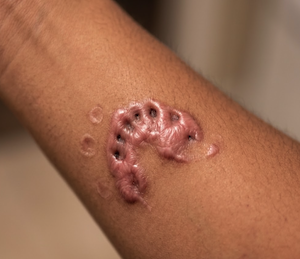
A critical concern in any disfigurement evaluation is the risk of a keloid.
Unlike an ordinary mature scare, a keloid is a thick, raised overgrowth of scar tissue that develops well beyond the original boundaries of the wound.
Keloids are notoriously difficult to treat. They also frequently recur, even after surgical excision.
Because of that risk, doctors must carefully consider whether a patient should undergo elective scar revision.
The objective of revision is to improve the appearance. It is not to trade an existing scar for a potentially worse one. For this reason, the medical literature emphasizes the risk of recurrence. It also emphasizes the need to individualize treatment.
This helps explain why plastic surgeons can be highly cautious about recommending surgery simply because a scar is present.
Why Doctors Are Reluctant to Promise Permanency
When a plastic surgeon is asked what a scar will look like four years in the future, the response may simply be:
“I don’t know yet.”
That is not evasive. In fact, it may be the only medically responsible answer. Scar formation is a complex biological process. It involves inflammation, proliferation, and remodeling.
In truth, permanent scars typically result when an injury extends deeply into the dermis. However, the final appearance depends on many variables. Those include the depth and characteristics of the wound, the body’s individual healing process, the location of the injury, and the patient’s individual genetics.
For example, a hypertrophic scar — one where the skin cells are enlarged — will shrink over time, unlike a keloid scar, which tends to grow. But the shrinking can take considerably longer than the traditional one-year estimate.
For example, a retrospective study of 361 hypertrophic scars found that average maturation times ranged from 22 to 36 months, depending upon age and treatment. Some patient groups took even longer.
Therefore, a surgeon who refuses to predict a definitive future appearance may simply be demonstrating sound medical judgment.
When Is Scar Revision Most Effective?
The ideal timeline for scar revision depends on the nature of the treatment being considered. The traditional approach is to delay surgical intervention for approximately 12 to 18 months.
Why?
Importantly, immature scars are highly unpredictable. Cutting into them prematurely can produce poor cosmetic results. Scars reach approximately 60% of their original skin strength by four to five weeks. However, complete maturation does not occur until approximately one year or longer. See Tullington & Gemma, “Scar Revisions,” Seminars in Plastic Surgery / PMC (2021).
That does not mean earlier treatment is never appropriate. Instead, the decision must be based on the particular scar and the particular circumstances.
Nonsurgical Alternatives
Modern research shows that laser treatments and other nonsurgical approaches do not necessarily require a rigid twelve-month wait.
For example, a recent study examining fractional laser revision in hypertrophic burn scars compared treatments initiated before six months with treatments started between six and twelve months. That research reflects a growing medical interest in earlier intervention. See Edward I. Lee & Edward I. Lee, “Update on Postsurgical Scar Management,” 24 Seminars in Plastic Surgery 25–33 (2010).
Ultimately, the pivotal question is not simply:
“Has it been a year?”
Instead, the better question is:
“What type of scar is this? How is it behaving? What treatment is being considered? And what are the risks compared with the expected benefits of treating it now rather than later?”
Those are questions a plastic surgeon can often answer without having to speculate about precisely what the scar will look like several years from now.
Aligning the Insurance Clock with the Medical Clock
Injured individuals must also navigate a harsh practical reality.
Insurance companies operate on a financial timetable. Human biology operates on a medical one.
Those two timetables do not always line up.
Insurance claims professionals routinely use internal benchmarks to determine when a scar is “mature” enough to evaluate for permanency.
In practice, we have encountered varying claims practices among major insurers:
- State Farm may evaluate scar permanency as early as four months.
- Liberty Mutual typically reviews permanency at approximately six months.
- Erie Insurance often waits until the one-year mark in more serious cases.
These windows are internal claims-handling guidelines. They are not binding legal or medical rules.
They also can vary by insurer, jurisdiction, and the severity of the claim.
Nevertheless, the practical takeaway is important:
The insurance company’s deadline will often arrive before the scar’s biological maturation is complete.
That creates a difficult legal gridlock.
The insurance company wants a final valuation today. However, the plastic surgeon responsibly refuses to guarantee what the scar will look like in three years.
And the injured client is caught in the middle.
Proving Permanency Without a Medical Crystal Ball
For injury victims in Pennsylvania, there is a way through this problem:
You do not necessarily need a plastic surgeon to predict the future.
Pennsylvania law recognizes that permanence can be established through the physical appearance of an injury, combined with the passage of a sufficient amount of time.
In the 2023 decision Waldinger v. Wokulich — a non-precedential decision (non-binding on future cases) but persuasive nevertheless — the Pennsylvania Superior Court addressed this exact dilemma. The case involved a two-inch wrist scar that remained visibly unchanged four years after an accident. The plaintiff failed to present expert medical testimony to establish permanency.
Nevertheless, the court concluded that this four-year history was sufficient evidence for a jury to determine that the scar was permanent.
Thus, while an opinion proving permanency is preferred, an attorney does not necessarily have to hunt for a doctor willing to guarantee a future aesthetic outcome.
Scar-Revision: Is it Necessary to Claim “Permanence”?
 In Pennsylvania, any party claiming damages has a duty to mitigate damages. For example, if a roofer leaves a giant opening in your roof, you can’t just let rain and snow come into your home and expect to recover money from the roofer for all resulting damage. Rather, it’s your duty to spend time and money to prevent further damage. The law requires you make a “reasonable” effort to fix the problem yourself before it gets worse, only then are you free to sue for all resulting damage.
And so how does this apply to scar-type injuries? You have a duty to take “reasonable” steps to improve the situation, which could include invasive, scar-revision surgery.
Only, many victims of dog attacks understandably refuse to undergo elective corrective surgery.
They have already survived a terrifying event.
They may have endured emergency-room visits, painful stitches, antibiotics, injections, and months of wound care. Then, after all of that, they are told that another procedure might improve the scar.
But that procedure has risks.
There may be risks of infection, poor healing or even worse: a new keloid scar as described above.
So the client may reasonably say:
“I just don’t want to go through this again.”
That decision does not necessarily mean the client has failed to mitigate her damages.
Fortunately, under Pennsylvania law, the duty to mitigate damages is not absolute. In Yost v. Union Railroad Co., 380 Pa. Super. 236, 551 A.2d 317 (1988) the Superior Court explained that an injured person is not legally required to undergo a medical procedure when the refusal is justified by pain, danger, expense, or an uncertain clinical outcome.
That principle is particularly important in the context of elective scar revision.
The question is not merely:
“Could surgery make the scar better?”
The better question is:
“Would a reasonably prudent person choose to undergo this procedure, given its potential benefits, risks, expense, inconvenience, and possibility of making the condition worse?”
A well-documented decision to decline elective scar revision is therefore not evidence of inaction.
Instead, it can be powerful evidence that the victim investigated the available options and made an informed, prudent decision to protect herself from further trauma and medical risk.
Eliciting the Right Medical Testimony
If a plastic surgeon is hesitant to offer a definitive opinion about permanency, an attorney should not necessarily stop there. Instead, the lawyer can ask practical, objective medical questions that doctors are much more comfortable answering.
For example:
- Is surgical revision a viable option for this specific scar?
- Does the tissue need to mature further before any procedure is attempted?
- Would laser therapy or steroid injections offer any measurable improvement?
- Does the scar exhibit characteristics of a hypertrophic scar or a keloid?
- What are the risks of treatment?
- What is the realistic expected outcome of a revision procedure?
This is often much more useful than asking a doctor to predict precisely what a scar will look like four years from now.
These questions can produce valuable medical evidence, without forcing the physician to engage in speculative forecasting.
Don’t Confuse a Fading Scar with a Disappearing Injury
A dog-bite claim does not vanish simply because a scar begins to fade.
Pennsylvania courts have recognized that a scar does not have to be grotesque to support financial recovery for disfigurement.
A jury can evaluate its daily visibility, symmetry, shape, color, and other characteristics.
More importantly, however, a dog attack is about far more than the final mark left on the skin.
Consider a victim with a small scar on her hand. The insurance defense may say: “It’s a tiny scar. It’s barely visible.”
But that argument may completely miss the reality of the trauma. That small scar may be physical proof of a terrifying defensive instinct.
Perhaps the dog was snapping at the victim’s face, making her instinctively threw up her dominant hand to protect herself. Ultimately, she never volunteered for this. She has no training in self defense, but the encounter forced her — against her will — to protect herself, anyway.
This is an important part of the story.
Moreover, the hand she used to protect her face may be the same hand she relies on every day, to:
- type
- drive
- cook
- clean
- care for children
- participate in recreation
So even a temporary loss of sensation, localized tenderness, nerve weakness, or reduced grip can represent a significant loss of quality of life.
That remains true even if the surface scar eventually becomes much lighter or disappears.
Conclusion: Evaluate the Whole Injury
In many cases, the visible surface scar may eventually fade into a minor blemish. Yet underlying nerve damage, numbness, or other physical symptoms may persist. But a scar does not have to be dramatic—or even permanent—for the underlying injury to have altered a victim’s life.
We can prove significant claims even without a doctor guessing about the future.
Contact Us Today
If you or someone you know suffered injuries from an animal attack in PA, contact us for a free consultation!
412.400.5476