
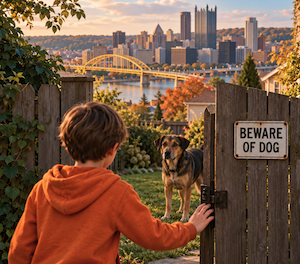
 Children make mistakes around dogs. They may pull a tail, poke a sleeping dog, try to ride it, or ignore a warning to stay away. After a bite, the dog owner’s insurance company may argue that the child shares the blame.
Can that argument reduce—or eliminate—the child’s compensation? In Pennsylvania, the answer depends heavily on the child’s age, ability to understand the danger, and actions before the bite.
The Child’s Age Matters
Pennsylvania recognizes that a minor — anyone under age 18 — may lack an adult’s judgment. Courts apply three age-based rules:
- Under age 7: Children are legally incapable of negligence. An insurer cannot assign comparative fault to a child in this age group.
- Ages 7 through 13: The law presumes that children cannot act negligently. The defense can overcome that presumption by showing that the child had the capacity, intelligence, and experience to recognize and avoid the danger. This protection weakens as the child approaches age 14.
- Age 14 and older: The law generally presumes that minors can act negligently, although they can present evidence of incapacity. Courts still ordinarily judge their conduct under a child’s standard of care.
For a child who can be negligent, the question is how other reasonably careful children of similar age, experience, capacity, and development would act in the same situation. An adult standard can apply to certain adult activities, such as driving. Ordinary interactions with dogs generally call for the child’s standard.
A Mistake Does Not Automatically Establish Fault
Pulling a dog’s tail, poking it, or trying to ride it may support a comparative negligence argument. But the defense must first overcome any age-based protection. It must also show that the child acted negligently and that the conduct contributed to the injury.
Consider a minor who ignores a “Dangerous Dog” sign and enters a garage containing the dog. Could the child read and understand the sign? Did the child know the dog was inside? Had someone explained the danger? Did the child understand that the dog might bite?
An older teenager who knowingly ignores a clear warning presents a different case from a young child who cannot understand it. A warning sign also does not automatically excuse an owner’s failure to take reasonable precautions.
How Comparative Negligence Affects Compensation
Pennsylvania generally reduces an injured person’s compensation by that person’s percentage of negligence. 42 Pa.C.S. § 7102. If the injured person bears more fault than the combined causal negligence of the defendants against whom recovery is sought, the person cannot recover on the negligence claim.
For example, assume a jury values a child’s injuries at $100,000 in a negligence case against one dog owner:
| Child’s share of fault | Effect on recovery |
|---|---|
| 20% | Compensation falls to $80,000 |
| 50% | Compensation falls to $50,000 |
| 51% | The child cannot recover |
These reductions apply only if the child can legally act negligently and the evidence supports assigning fault. A jury cannot reduce a six-year-old’s recovery simply because it believes the child should have been more careful.
Provocation: A Much Better Defense
Claiming comparative negligence is only one way to defend a dog bite claim. Another is provocation, where the minor’s conduct causes a dog to become aggressive. Importantly, provocation is always a valid defense, even when the minor is younger than seven. This covers many of the common scenarios where a young one get bit, such poking the dog, pulling its tail, or antagonizing it in other ways, innocently or not.
In fact, it’s often the child’s burden to prove the absence of provocation, even if the defendant fails to raise this defense.
For example, some claims rely on a violation of Pennsylvania’s Dog Law to establish negligence. This often requires the claimant to show the attack occurred without provocation. In that setting, provocation challenges an essential part of the claim. It is not simply an affirmative defense that the owner must prove. Thus, even with a slight degree of provocation (1% for example), it can defeat the Plaintiff’s entire claim where the Plaintiff must prove the absence of provocation. Contrast this with the comparative negligence concept, where the plaintiff can still recover money, even if fifty percent at fault.
Further, with provocation, the child’s intent is not the key factor. It’s whether the conduct — intended harmlessly or not — was enough to provoke an otherwise good dog into biting.
But the child’s age, actions, and surrounding circumstances still matter. An insurer cannot establish provocation merely by showing that the child interacted with the dog. In Eritano v. Commonwealth, the Pennsylvania Supreme Court held that a five-year-old eating chicken had not provoked the dog that lunged for the food and injured her.
Blaming the Injured Minor Can Backfire
 Blaming an injured plaintiff carries risks. When the strategy works, it can reduce or defeat the plaintiff’s claim. When it fails, it can backfire spectacularly and produce a much larger verdict than the defendant expected.
Jurors often want parties to take responsibility for their actions. An effort to blame the injured person can look like an attempt to avoid accountability. Some jurors may initially prefer to view the injury as “just an accident”—an unfortunate event with no villain and no one to blame. That outlook can favor the defense.
But when the defense actively blames the plaintiff, it changes the courtroom dynamic. The defense asks jurors to assign fault, weakening the idea that this was simply a random accident. Once the defendant invites that scrutiny, jurors may direct it squarely at the defendant.
What If the Parent Failed to Supervise?
An insurer may also argue that a parent should have watched the child more closely. Pennsylvania does not count a parent’s negligence as the minor’s negligence. The child has a separate injury claim. A parent’s failure to supervise cannot, by itself, reduce or defeat that claim.
Suppose a parent attends a birthday party with a young child. The host keeps a dog in a separate room. Despite knowing about the danger, the parent negligently allows the child to enter that room.
If the dog bites the child, the parent’s mistake does not make the minor comparatively negligent. The claim against the dog owner still depends on whether the owner bears legal responsibility for the attack.
Can the Dog Owner Bring the Parent Into the Lawsuit?
Yes, but it is highly unlikely.
Parents are not liable for their child’s conduct, unless the minor’s conduct was willful or malicious. Even then, parental liability is capped at only $1,000. See 23 Pa.C.S. § 5508.
As a practical matter, proving intent to harass a dog is tricky. Often, the just is “just playing” and not intending to provoke the dog.
Thus, as a practical matter, it’s almost certainly not worth the time, or the cost of filing and sheriff service cost to sue a parent over this.
Still, the dog owner may seek to join the parent as an additional defendant. The owner must allege facts showing that the parent’s own negligence helped cause the injury. Pennsylvania courts recognize claims seeking contribution from parents who negligently supervised their injured children.
The defense must do more than argue that closer supervision could have prevented the bite. Parents do not have to provide perfect, uninterrupted supervision. Courts ask what a reasonably careful parent would have done under similar circumstances. A momentary misjudgment does not necessarily establish negligence.
Look Beyond the Insurer’s Accusations
Comparative negligence can significantly affect a Pennsylvania dog bite claim, especially when an older child knowingly disregards a danger. But an insurer cannot treat every childhood mistake as legal fault.
The minor’s age, understanding, and conduct all matter. So does the distinction between comparative negligence, provocation, and a parent’s separate responsibility. Families should examine those issues before accepting an insurer’s claim that a child was “partly to blame.”
Contact Us Today
We regularly represent children making a claim for a dog bite in PA. For more, click here. Or talk to us for a free case evaluation.
412.400.5476 – Call or Text!