
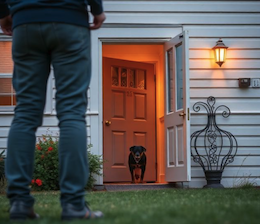
 If a dog escapes another’s property and attacks you on yours, that’s easy: clear liability in PA.
But let’s say you were bitten by a dog while you’re standing on another’s real property as a social guest, delivery driver, etc.
Whether you were invited onto the property, merely had permission to be there, or entered without permission can significantly affect the legal duties owed to you by the dog owner and the property owner.
A recent Pennsylvania trial court decision reinforces an important principle: whether an injured person is an invitee, licensee, or trespasser is often a question for the jury—not something a court should decide at the very beginning of the case. That distinction can make all the difference in a dog bite lawsuit.
Why Your Legal Status Matters
Pennsylvania premises liability law generally recognizes three categories of people entering another person’s property:
- Invitees
- Licensees
- Trespassers
Each category is owed a different duty of care by the property owner.
When a dog bite occurs on private property, the victim’s legal status frequently becomes one of the first issues raised by the insurance company or defense attorney.
Invitees: The Highest Level of Protection
An invitee is someone who is on the property for a purpose connected with the owner’s interests or because the owner has expressly or impliedly invited them onto the property.
Examples include:
- Guests invited for Christmas dinner
- Friends attending a birthday party
- Contractors hired to perform work
- Mail carriers
- Amazon, UPS, FedEx, and other delivery drivers making scheduled deliveries
- Utility workers
- Customers entering a business.
Property owners owe invitees the highest duty of care. Pennsylvania follows the Restatement of Torts § 343 with respect to defining the duty owed to an invitee.
Generally speaking, they must (1) use due care to look out for danger, (2) then use reasonable care to keep the premises safe and (3) warn invitees of dangerous conditions they know about—or should know about—including dangerous dogs.
Licensees: Social Guests and Others with Permission
A licensee is someone who has permission to enter the property but is there primarily for his or her own purposes rather than for the owner’s business benefit.
Examples include:
- Friends stopping by unexpectedly
- Neighbors visiting
- Someone dropping off a personal item
- A relative who visits without a formal invitation but is welcome
Here, the property owner need not investigate for hidden dangers, unlike the duty to invitee.
Although property owners owe licensees a somewhat lower duty than invitees, they still must warn of known dangerous conditions that are not obvious—including known dangerous animals.
If the homeowner knows a dog has aggressive tendencies and fails to warn a social guest, liability may still exist.
Example
Imagine cousins travel from out of town for a family Christmas gathering. The homeowners know that one of the guests might bring their pitbull that has previously shown aggression toward strangers but the homeowner defers to the dog owner to control their pet while guests arrive.
Under the Dangerous Dog Law, liability can exist for the party who owns or harbors the dog not the property.
But what if that guest has no money or insurance?
The injured party may need to pivot from the dog owner to the property owner and rely a premises liability theory (governing slip and falls or other property-related injuries), versus a Dangerous Dog Law claim. Here, they key question turns on whether the invited family member is an invited guest, to whom the property owner had a duty to (1) correct known dangers and, failing that, (2) warn guests of the dangers.
Here, the homeowner may be liable under traditional negligence and premises liability principles.
Trespassers: Not Always an Automatic Defense
Insurance companies often assume that if someone is technically trespassing, there can be no recovery.
That is not always true.
Generally, property owners owe trespassers a more limited duty. However, Pennsylvania law recognizes numerous exceptions and factual situations where liability may still arise.
For example, courts often examine:
- Why the person entered the property
- Whether the entry was foreseeable
- Whether the property owner knew people commonly entered the property
- Whether the owner intentionally or recklessly created danger
- Whether children were involved
- Whether the dog owner’s conduct was otherwise negligent
The label “trespasser” does not automatically end the analysis.
What About an Amazon Driver Who Goes to the Wrong House?
Consider a situation that occurs surprisingly often.
An Amazon driver intends to deliver a package to 123 Main Street but accidentally walks onto the porch of 125 Main Street.
The homeowner opens the door, and their dog attacks.
Was the driver technically on property where he had no permission to be?
Perhaps.
Does that automatically make him a trespasser with no case?
Not necessarily.
The driver’s entry was entirely foreseeable. Delivery drivers routinely enter residential property every day. The homeowner may have no way of knowing whether the driver simply has the wrong address, is delivering a neighbor’s package, or is responding to another legitimate reason for approaching the home.
Whether the driver should legally be classified as an invitee, licensee, or trespasser—and what duties were owed under those circumstances—may involve disputed facts that should be decided by a jury.
Postal Workers, Utility Employees, and Other Workers
The same analysis often applies to:
- USPS letter carriers
- FedEx and UPS drivers
- Food delivery drivers
- Electric, gas, cable, and internet technicians
- Census workers
- Emergency responders
Even when questions arise about whether they were exactly where they were supposed to be, courts frequently look beyond technical property boundaries and examine the practical realities of why they entered the property.
The Recent Martin Decision Reinforces This Principle
A recent Pennsylvania trial court decision, Martin v. Cable Services Co., Inc., No. CV-2025-00988 (C.P. Lycoming County Apr. 23, 2026), illustrates an important procedural point that can affect many premises liability cases—including dog bite cases.
In Martin, the defendants asked the court to dismiss the lawsuit at the preliminary objection stage, arguing that the complaint failed to establish that the deceased individual was a public invitee and therefore failed to establish any duty of care.
The court refused.
Judge William P. Carlucci explained that the determination of whether someone is an invitee, licensee, or trespasser is generally a question of fact for the jury, not an issue that should ordinarily be decided before evidence is developed through discovery.
The court also observed that foreseeability—the question of whether the harm should reasonably have been anticipated—is likewise usually a factual issue for the jury.
Although Martin did not involve a dog bite, its reasoning applies broadly to Pennsylvania premises liability cases. In many dog bite lawsuits, defendants argue early in the case that the victim was merely a trespasser and therefore owed little or no duty. Martin serves as another reminder that courts should be cautious before deciding those factual issues without allowing the parties to fully develop the evidence.
Contact Us Today
If you or someone you love has been bitten by a dog in Pennsylvania, an experienced attorney can evaluate your right to recover compensation.
412.400.5476