
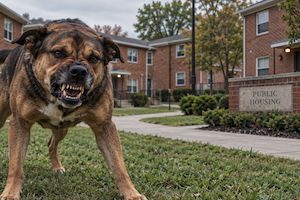
 Let’s say a dangerous dog attacks someone at a public housing complex. Before the attack, residents warned the housing authority about the dog. Yet the authority failed to address the danger.
Those facts may suggest negligence. However, successfully bringing a claim against a governmental landlord requires more than proving that it knew about a danger and failed to act. Pennsylvania’s immunity laws impose additional barriers. Even when an injured person overcomes those barriers, statutory limits can sharply restrict compensation.
Even a Claim Against a Private Landlord Is Difficult
We’ve written about the challenges of suing a landlord for an attack by the tenant’s dog.
In short, a landlord does not automatically become responsible when a tenant’s dog bites someone. Far from it. Under Pennsylvania law, a claim against an out-of-possession landlord generally requires proof that the landlord actually knew of the dog’s dangerous propensities and had the right to control or remove the animal, including by retaking possession of the premises. Palermo v. Nails, 483 A.2d 871, 873 (Pa. Super. Ct. 1984).
Actual knowledge matters. Evidence that the landlord merely should have known about the danger generally does not satisfy this standard. Knowing that a tenant owns a dog is also different from knowing that the dog presents a danger.
Timing matters as well. An injured person must connect the landlord’s failure to take reasonable action with the eventual attack. That requires examining when the landlord learned of the danger, what the lease permitted, and what protective measures could reasonably have prevented the injury.
 Plus the victim must prove a nexus between the property and the attack.
Examples include:
- the landlord fails to maintain their fence, causing an opening big enough for a dog to escape, or
- A door latch — maintained by the landlord — broke, causing the dog to escape, or
- The landlord’s invisible fence system failed.
This nexus matters. But when the landlord is a governmental entity, the connection to the property becomes an additional legal obstacle.
Governmental Immunity Adds Another Barrier
Pennsylvania generally protects Commonwealth agencies and local governmental entities from tort liability, subject to specific statutory exceptions. An injured person must establish both an otherwise valid negligence claim and an applicable exception to immunity. See 42 Pa. Cons. Stat. §§ 8522, 8542.
The entity’s legal classification is critical. A housing authority bearing a county’s name may nevertheless receive Commonwealth sovereign immunity. That was the framework applied in Hand v. Clinton County Housing Authority, No. 742 C.D. 2024 (Pa. Commw. Ct. Oct. 20, 2025) (unreported memorandum opinion).
Although Hand involved a shooting rather than a dog attack, its reasoning explains why a dangerous-dog claim against a housing authority can face substantial difficulty.
What the Hand Decision Shows
According to the complaint in Hand, a tenant repeatedly reported troubling behavior by a neighboring resident. The reports included yelling, slamming objects, standing outside her window, and damaging the shared wall between their apartments. The neighbor later fired a gun through the shared wall and at her vehicle. She alleged resulting mental and emotional injuries.
The tenant sued the housing authority, alleging that it failed to take reasonable action despite the warnings. The trial court allowed the case to proceed. However, the Commonwealth Court reversed, holding that the complaint failed to identify an applicable exception to sovereign immunity.
The decisive problem was the absence of a dangerous condition of the real estate itself that caused the injury. The complaint identified the neighbor’s presence and conduct. Those allegations did not establish the necessary property defect. Hand, slip op. at 7–9.
The court distinguished an earlier case involving an assault in which a protruding metal pipe on housing authority property contributed to the victim’s injury. In that situation, a physical feature of the property supplied a possible basis for applying the real estate exception. See Wilson v. Philadelphia Housing Authority, 735 A.2d 172 (Pa. Commw. Ct. 1999).
Hand is an unreported memorandum opinion, rather than binding precedent. Nevertheless, its application of the immunity rules offers a useful warning for anyone evaluating a claim against a governmental landlord.
A Danger on the Property Is Not Necessarily a Condition of the Property
For the Commonwealth real estate exception, the distinction between a danger on the property and a dangerous condition of the property can determine whether a case proceeds.
In Snyder v. Harmon, 562 A.2d 307 (Pa. 1989), the Pennsylvania Supreme Court ruled that for the real estate exception to sovereign immunity to apply, the dangerous condition must derive, originate from, or have as its source the Commonwealth realty itself.
Applied to a dog attack, this reasoning creates a serious obstacle. Proof that a housing authority knew a tenant’s dog was dangerous may support the negligence analysis. It does not, by itself, establish that the injury resulted from a dangerous condition of the real estate.
Similarly, allegations that the authority failed to evict the tenant or post warnings do not automatically satisfy the real estate exception. The claimant still must identify a qualifying condition of the property and show how it caused the injury. Even a physical defect requires careful analysis: a condition that merely facilitates an attack may be insufficient.
Other immunity exceptions must also be evaluated under their own requirements. For example, the statutory animal exceptions concern animals in the governmental entity’s possession or control. A tenant’s ownership of a dog on government property does not automatically establish governmental possession or control. See 42 Pa. Cons. Stat. §§ 8522(b)(6), 8542(b)(8).
The Six-Month Notice Requirement Requires Prompt Attention
There is also an early procedural requirement. Under 42 Pa. Cons. Stat. § 5522(a), a person pursuing an injury claim against a government unit generally must file a signed written notice within six months after the injury or accrual of the claim. The notice must contain specified identifying information, the date and hour of the accident, its approximate location, and attending physician information.
The notice must be filed with the correct government unit. For a claim against a Commonwealth agency, it must also be filed with the Pennsylvania Attorney General.
A lawyer should prepare the notice, identify the proper recipients, and document timely delivery. Certified mail, return receipt requested, is a prudent way to establish receipt, although Section 5522 itself does not expressly mandate that mailing method.
The statute includes exceptions and grounds for excusing noncompliance. Nevertheless, an injured person should seek legal advice promptly rather than rely on those provisions. A prior complaint about a dangerous dog should not be assumed to satisfy the separate notice requirement for a later injury claim.
Even a Successful Claim Faces Damages Caps
Overcoming immunity does not guarantee full compensation. For ordinary negligence claims governed by these statutes, Pennsylvania imposes the following limits:
| Governmental defendant | Statutory damages limit |
|---|---|
| Commonwealth agency | $250,000 in favor of any plaintiff, with a $1 million aggregate limit for the same occurrence or related occurrences |
| Local governmental entity | $500,000 in the aggregate for the same occurrence or related occurrences |
The Commonwealth limits appear in 42 Pa. Cons. Stat. § 8528(b). The local-government limit appears in 42 Pa. Cons. Stat. § 8553(b). The $500,000 local limit is an aggregate ceiling, rather than a separate allowance for every injured person.
For a negligence-based dog-bite claim subject to these provisions, the severity of the injury does not increase the statutory ceiling. Months of hospitalization, permanent disability, an amputation, or death can produce losses far exceeding the amount recoverable from the governmental defendant.
That makes early investigation especially important. A lawyer must evaluate the governmental entity’s status, preserve evidence of prior warnings, examine control over the dog and property, satisfy the notice requirement, and determine whether the facts fit an immunity exception. Claims against the dog’s owner and other responsible private parties may also provide avenues for recovery.
A written warning about a dangerous dog can be powerful evidence. Against a governmental landlord, however, it is only one part of a much more demanding legal analysis.
Contact Us Today
Talk to a lawyer before assuming any claim is too challenging to pursue. Don’t wait too long. Contact us today for a free consultation!
412.400.5476