
 Pennsylvania dog bite law has evolved significantly, and much of that evolution centers on how statutory violations translate into civil liability through negligence per se.
As we’ve discussed elsewhere on this site, Pennsylvania courts recognize negligence per se when a defendant violates a statute designed to protect a particular class of individuals, and that violation causes the type of harm the statute was intended to prevent.
We’ve also previously explained a major shift in Pennsylvania law in 2024: under Section 502 of the Pennsylvania Dog Law, the Commonwealth eliminated the old common-law requirement that a plaintiff prove a dog’s prior vicious propensities. Today, any unprovoked attack on a human constitutes a violation of the Dog Law—triggering not only potential criminal liability, but also forming the basis for civil liability, where the pet:
(iii) attacked [any] human being without provocation
This, however, requires an attack on a human.
But what if the dog never targeted a human, either in this case or any prior instance, showing no prior aggressive behavior toward people at all? What if, instead, the dog attacks another dog and, in the fray, a human gets injured indirectly?
Fortunately, another section exists and it focuses on the type of injury, not the target of the attack, creating liability when a dog has:
(i) inflicted severe injury on a human being without provocation on public or private property…
* * *
Significance of “Severe Injury”
 This distinction becomes especially important in the common, this real-world scenario we discussed: a dog attacks the victim’s dog, not the person. The victim intervenes to protect their pet and, in the process, suffers a serious injury. In the chaos of these encounters, the victim’s own dog often bites them—a frequent occurrence that gives rise to a predictable defense. The defendant will argue that their dog did not cause the injury at all, instead placing blame on the victim’s dog.
That argument, however, loses much of its force if the injury qualifies as “severe.” Once that threshold is met, the law does not require the victim to prove which specific dog inflicted the bite. Technical evidence—such as bite mark analysis—becomes unnecessary. Instead, the focus shifts to the nature of the injury itself.
Even so, this pathway is not automatic. The victim must still establish that the injury meets the statutory definition of “severe,” and that requirement often becomes the central issue in litigation.
* * *
The Statutory Framework: What Counts as a “Severe Injury”?
Under Pennsylvania’s Dog Law, 3 P.S. § 459-102, a “severe injury” is defined as:
Any physical injury that results in broken bones or disfiguring lacerations requiring multiple sutures or cosmetic surgery.
Although the definition appears straightforward, it creates two distinct categories that operate quite differently in practice:
- broken bones; or
- disfiguring lacerations requiring multiple sutures or cosmetic surgery
The first category is relatively simple. The second is where most disputes arise.
* * *
Broken Bones: A Straightforward Standard
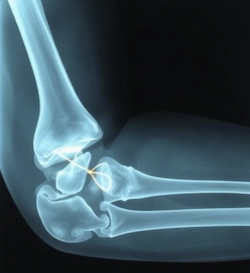 The statute treats “broken bones” as a self-defining concept. It does not qualify the term in any way. There is no requirement that the fracture be severe, require surgery, or even require treatment. The statute simply says: broken bones.
Thus, if the victim falls to the ground while protecting their dog from an attack, the victim’s mere hairline fracture to the hip, elbow, knee, or wrist will suffice.
That simplicity contrasts sharply with the second category, which introduces layered requirements and significantly more room for dispute.
* * *
Disfiguring Lacerations and the “Sutures” Requirement
In most contested cases, the focus shifts to whether an injury qualifies as a “disfiguring laceration requiring multiple sutures.” This is where the analysis becomes more nuanced and fact-intensive.
Two questions tend to drive the inquiry:
- What does it actually mean for a laceration to be “disfiguring” or “severe”?
- What does it mean for an injury to “require” sutures—particularly when no sutures were ever used?
The second question, in particular, has been the subject of significant judicial interpretation.
* * *
Sutures Need Not Be Used—But They Must Be Needed
Pennsylvania courts have made one principle clear: an injury does not need to be sutured to qualify as “severe,” but there must be evidence that sutures were medically necessary.
This distinction reflects a practical reality in both human and veterinary medicine. Bite wounds are often intentionally left open due to the risk of infection. Closing such wounds can trap bacteria and lead to complications, so medical professionals frequently choose not to suture them. As a result, the absence of sutures does not necessarily indicate that an injury was minor.
Courts recognize this. However, they draw a firm line between medical judgment and evidentiary proof. While sutures need not have been performed, there must still be competent evidence that they were required. Without that evidence, a claim of “severe injury” cannot stand.
* * *
How Courts Apply the Rule
The case law illustrates how strictly this requirement is enforced.
Commonwealth v. Morgera, 836 A.2d 1070, 1073 (Pa. Cmwlth. 2003)
In Morgera,, the court confronted a situation where an animal attack caused puncture wounds, but no sutures were used. The treating veterinarian testified that she typically does not suture that type of injury. Although the wounds were real and required treatment, the court found the evidence insufficient to establish a “severe injury.” The key takeaway is straightforward:
- no sutures, combined with no medical testimony establishing necessity, means no severe injury
Courts will not infer the need for sutures based solely on how an injury appears.
By contrast, cases like Commonwealth v. Hefferon demonstrate sufficient proof. There, the victim sustained multiple lacerations that required eight sutures, along with visible bleeding and cuts. That combination—objective treatment and observable injury—easily satisfied the statutory definition.
Eritano v. Commonwealth, 547 Pa. 372, 690 A.2d 705 (1997)
Similarly, in Eritano, the court found a “severe injury” where a child suffered bites to the face and neck that required plastic surgery and resulted in permanent scarring. The decision underscores an important point: cosmetic surgery alone is enough to meet the statutory threshold, and facial injuries are a classic example of disfiguring lacerations.
Commonwealth v. Dougherty, No. 1171 C.D. 2023 (Pa. Commw. Ct. Nov. 14, 2024)(unreported)
More recently, Dougherty reinforces the limits of the doctrine. In that case, multiple dogs attacked another dog, causing severe and graphic injuries documented by photographs. A witness testified that a veterinarian had indicated sutures would be needed, but no sutures were actually performed.
The trial court relied heavily on the photographs and witness descriptions, concluding that the injuries were “obviously severe.” The appellate court disagreed and reversed. It emphasized that the need for sutures was not self-evident and that the record lacked reliable evidence explaining why sutures were not used. Without that explanation, the court refused to infer medical necessity.
The lesson from Dougherty is critical:
- even graphic, disturbing injuries are not enough
- courts require affirmative, competent evidence of medical necessity
- speculation—no matter how reasonable—is insufficient.
* * *
What Counts as Proof of Medical Necessity
Taken together, these cases establish that courts look for objective, medical evidence when determining whether sutures were “required.” This may include:
- testimony from a treating physician or veterinarian
- expert opinion that the wound should have been sutured
- medical records describing the depth of the injury, tissue separation, or standard treatment protocols
By contrast, certain types of evidence, while persuasive at a glance, are not sufficient on their own:
- photographs, even if graphic
- lay opinions about whether stitches were needed
- the mere absence of sutures without explanation
* * *
Negligence Per Se and the Role of “Severe Injury”
When a dog causes a “severe injury” during an unprovoked attack, that statutory violation can support a negligence per se claim. But as case law makes clear, establishing “severe injury” is often the most contested part of the analysis.
In practice:
- the statutory violation must be shown; and
- the injury must meet the statutory definition
And where the claim depends on lacerations:
- It is not enough to show that the injury was serious
- There must be proof that the sutures were medically necessary
* * *
Bottom Line
Pennsylvania courts take a disciplined, evidence-driven approach to the phrase “requiring multiple sutures.” They recognize the realities of medical treatment and do not require that sutures actually be performed. But they consistently insist on proof that sutures were needed.
Without that proof, even injuries that are serious, bloody, and visually disturbing may fail to qualify as “severe” under the statute.
That distinction is not academic. It can determine whether negligence per se applies—and, in many cases, it can shape the entire outcome of a dog bite claim.
* * *
Contact Us Today!
Our attorneys provide a free consultation; learn your rights to recover compensation for all the consequences of your injuries in PA.
412.400.5476