
Investigating Dog Bite Claims

Canine attack cases often begin with very little reliable information. A victim may know only the dog owner’s first name, a vague description of the animal, or the location where the attack occurred. In transient settings—public parks, sidewalks, or apartment complexes—the alleged owner may be a passerby, a renter, or someone without easily traceable local records. Before filing suit, a lawyer or claimant must determine whether the case is viable and who the proper defendant actually is.
One of the most effective early investigative tools is a Right-to-Know (RTK) request to animal control or a county department of health, such as the City of Pittsburgh (click here) or the Allegheny County Health Department.
When it works, an RTK can advance the investigation without immediately resorting to litigation.
The Value of Early Information
An RTK request to animal control (i.e. city or county health department) is 100% free and can yield several categories of information that are extremely useful in assessing a case:
- Incident reports describing the animal attack and how it occurred
- Identification information for the dog owner or custodian
- Vaccination status of the dog
- Quarantine records and rabies monitoring documentation.
- Prior complaints involving the same dog or owner
This information can reveal whether the claim has enough substance to justify filing a lawsuit.
Otherwise, in some cases, a claimant risks filing a complaint based on incomplete or unreliable details—potentially initiating litigation that later proves to be frivolous or directed at the wrong party.
The Problem With Using Litigation For Investigation
If the RTK process fails or is denied, the typical fallback is to file a lawsuit and then use formal discovery tools such as subpoenas to access animal control’s records. However, that approach carries risks.
To issue a subpoena in Pennsylvania, a party must first file suit and obtain a docket number. By doing so, the claimant has already committed to litigation. If the facts later show that the case lacks merit or that the wrong defendant was named, the plaintiff may face dismissal, unnecessary litigation costs, or even sanctions.
For this reason, obtaining meaningful information before filing suit is not just helpful—it can be essential.
Attacks Inside the City of Pittsburgh
If the attack occurred inside the City of Pittsburgh, your RTK request to the City will likely prove worthwhile. Here’s an actual response to one of our recent requests when investigating a dog bite:
Dear Mr. Elliott:
On February 3, 2026, the City of Pittsburgh’s Open Records Office received your request for records under the Pennsylvania Right to Know Law (“RTKL”), 65 P.S. § 67.101 et seq. You requested: Requesting the dog bite report from a dog bite to Laurisa XXXX on 8/18/2025 at XXXX St., Pittsburgh, PA 15206. After performing a good-faith search, the City’s Open Records Office was able to locate the enclosed records.
But what if you’re just outside the City but within Allegheny County?
Allegheny County RTK Requests Are Often Denied
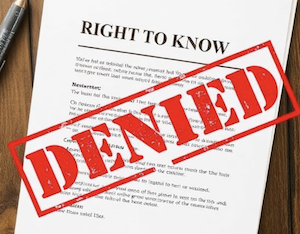 At the county level, RTK requests related to dog bites frequently encounter resistance. County departments of health often argue that responsive records contain protected health information related to potential rabies exposure. Because rabies investigations involve public health considerations and medical information, counties sometimes take the position that the records fall outside the scope of what must be disclosed under Pennsylvania’s Right-to-Know framework.
As a result, otherwise straightforward requests for incident reports or investigation records may be denied or heavily redacted. Here’s an actual denial from the Allegheny Health Department:
The Allegheny County Health Department has located records within the scope of your request that are not being provided.
Really? What’s the reason?
Information connected with the reporting of diseases, including dog bites. . . are exempt from access pursuant to the RTKL. . . In this instance, the ACHD records that you have requested are specifically exempt from disclosure under the Disease Prevention and Control Law (DPLC) 35 P.S. § 521.15.
A Practical Strategy: of Strategic Initial Reporting
A practical workaround is to ensure that the dog bite is reported—at the outset–to the Pennsylvania Department of Agriculture (PDA), i.e., a state agency, separate from the city or county health department.
This is also free of charge.
When the PDA receives a complaint, it typically opens a public health investigation relating to rabies exposure and quarantine procedures, creating a written record at the state agency level.
This step can be important for two reasons:
1. The PA Department of Agriculture often responds to RTK requests more readily.
State-level agencies frequently provide responsive records more quickly and with fewer objections than county departments. Below is an actual response from Pennsylvania Department of Agriculture (PDA) in one of our dog bite cases:
On February 9, 2026, the Agency Open Records Officer of the Pennsylvania Department of
Agriculture (PDA) received your request for information pursuant to the Pennsylvania Right-
To-Know Law, 65 P.S. §§ 67.101, et seq. (RTKL). PDA may deny your request [if it pertains to a] record of an agency relating to a criminal investigation, including complaints and complainants, is exempt from disclosure pursuant to Section 67.708 (b)(16) of theRTKL. However, [y]our request is granted.
2. It creates a second record source.
Even if the county denies an RTK request, the PDA’s investigation may produce parallel records— reports or intake documentation—that provide useful details about the incident.
In practice, responses from the PDA are often delivered electronically and relatively quickly, allowing claimants to gather at least some information about the event before deciding whether to pursue litigation.
Continue Reporting to City or County Animal Control
Although the Commonwealth (i.e. PDA) may be most responsive to RTK requests, it is still important to report the dog bite to local animal control authorities (the city or county department of health). Local authorities perform the core investigative work, including:
-
- Locating the dog and its owner
- Confirming vaccination status
- Ordering and monitoring quarantine
- Determining whether rabies testing is required
Animal control creates the primary record of the incident. Even if access to those records is later disputed under an RTK request, the investigation itself helps establish a documented history of the event.
Why This Dual-Reporting Approach Matters
Reporting the dog bite both to the PDA and to county animal control (if outside the City of Pittsburgh) creates overlapping records. This redundancy can be extremely valuable when information about the defendant is otherwise scarce.
The official investigation may be the only reliable source of identifying the owner of the dog, if:
- identified only by first name at the scene
- co-owners exist, as potential additional defendants or
- the attacking dog was being “harbored” (walked or otherwise possessed) by someone other than the record owner.
When the county denies an RTK request, the Commonwealth’s records may still reveal enough detail to identify the responsible party or confirm whether the claim is worth pursuing.
Parenthetically, what about seeking a police report?
The Limited Role of Police Reports
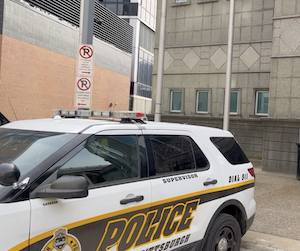 Though animal control has primary jurisdiction over dog bite matters–including bringing criminal charges–the police have some overlapping jurisdiction in many dog bite situations. However, in practice, law enforcement often defers to animal control and public health authorities.
As a result, police incident reports may contain little substantive information—typically only that animal control or the health department was notified. Thus, the police investigation can prove helpful, but mainly as a last resort.
Conclusion
For claimants and attorneys evaluating a dog bite case, early information is critical. A well-timed Right-to-Know request to animal control can provide key facts that help determine whether a case is viable and who the correct defendant should be.
However, because counties may deny RTK requests on public health grounds, the most effective strategy is often to ensure that the incident is reported both to local animal control (city and/or County) and also to the Commonwealth at the outset. Doing so creates multiple investigative records and increases the chances of obtaining useful information before filing suit.
In situations where the identity of the dog owner is uncertain or the merits of the claim are unclear, that information can mean the difference between filing a well-supported complaint (that makes the claimant sound credible from the outset) and initiating questionable litigation.
Contact Us Today!
Contact our lawyers today for free to learn more about your rights to recover compensation for all the consequences of your injuries.
412.400.5476