
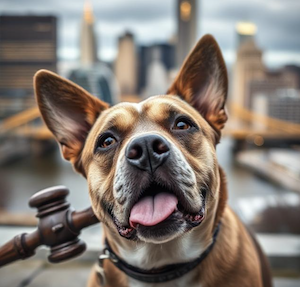
 Most states have adopted a strict liability standard for injuries from a canine bite, meaning, the victim need not prove “negligence” to obtain a recovery.
But Pennsylvania historically has refused, finding “strict liability” only for the payment of medical bills, but not “pain and suffering, disfigurement, or loss of wages.
PA’s criminal statute–which also sets the standard for negligence–created something like strict liability in any one of the following instances:
(1) The dog has done any of the following:
(i) Inflicted severe injury on a human being without provocation on public or private property.
(ii) Killed or inflicted severe injury on a domestic animal, dog or cat without provocation while off the owner’s property.
(iii) Attacked a human being without provocation.
(iv) Been used in the commission of a crime.
Until January of 2024, the claimant also needed to show:
(2) The dog has either or both of the following:
(i) A history of attacking human beings and/or domestic animals, dogs or cats without provocation.
(ii) A propensity to attack human beings and/or domestic animals, dogs or cats without provocation. A propensity to attack may be proven by a single incident of the conduct described in paragraph (1)(i), (ii), (iii) or (iv).
The Current Law – Effective January of 2024
 In 2023, Pennsylvania amended its Dangerous Dog Law to expand criminal liability (and therefore civil liability, discussed below) for all unprovoked pet attacks, removing the requirement to also show: “(i) A history of attacking human beings and/or domestic animals, dogs or cats without provocation.(ii) A propensity to attack human beings and/or domestic animals, dogs or cats without provocation.”
This change broadens the scope of accountability for pet owners or those harboring the animal that bites. See 3 P.S. § 459‑100 et seq., part of Pennsylvania’s “Dog Law” in Chapter 8 of Title 3 (Agriculture).
In fact, section 459‑502‑A(a)(1) of the Law expressly creates liability on the part of the “owner” or person “harboring the dog” (dog walker, etc.) where the pet:
(i) inflicted severe injury on a human being without provocation on public or private property, [or]
(ii) killed or inflicted severe injury on a domestic animal, dog or cat without provocation while off the owner’s property, [or]
(iii)attacked [any] human being without provocation, [or]
(iv) been used in the commission of a crime.
Click here to read New Section 502-A, as amended on Oct. 23, 2023, effective for all incidents in January of 2024 to the present. The law is not retroactive to attacks prior to January of 2024, however.
So now, court should primarily look for two things.
-
- One: did the defendant own or harbor the dog at the time of the attack?
- Two: did did the victim “provoke” the dog into attack?
Provocation More Important Than “Dangerous Propensity.”
As Section 502-A currently stands–and until the courts interprets it otherwise–a Plaintiff need only show that the attack on a human was “without provocation.”
What is provocation? Provocation existed where:
-
- A child approached a recently fed dog that attacked. See In re Renieli, No. P94-11-030 (Pa. Ins. Comm’r. Jan, 17, 1997).
Courts have found that no provocation existed where:
-
- a dog was simply excited. See Commonwealth v. Baldwin, 767 A.2d 644 (Pa. Cmwlth. 2001),
- a neighbor spoke to a leashed dog owner without touching the dog. See Commonwealth v. Civello, 1998 C.D. 2012 (Pa. Cmwlth. 2012)* (unpublished opinion).
Ultimately, prosecutors — and the plaintiff in a civil case — bear the burden of proving a lack of provocation.
Massive Impact in Civil Cases
In Pennsylvania, violation of a criminal statute can also create civil liability based on a concept called “negligence per se.” This will apply, if the plaintiff demonstrates:
-
- a violation of a statute caused the kind of harm the statute was intended to prevent; and
- the plaintiff was within the class of persons the statute was designed to protect.
Two Pennsylvania Superior Court cases involving dog attack lawsuits, Miller v. Hurst, 302 Pa. Super. 235 (1982) and Underwood vs. Wind, et al., 2008 Pa. Super. 158 (2008). In each, the courts have held that a violation of the Dog Law constitutes negligence per se.
Regarding the 2024 amendments, Pennsylvania courts have not yet expressly ruled on whether, in a civil case, a dog attack still requires proof of negligence. However, it looks very promising that the courts will now apply a strict liability standard for any pet-related injury from an unprovoked pet. To date (as of September 2026), no court has interpreted the 2024 amendment.
Let’s Get Started!
Contact our professionals for free to learn more about your rights to compensation following an injury.
412.400.5476